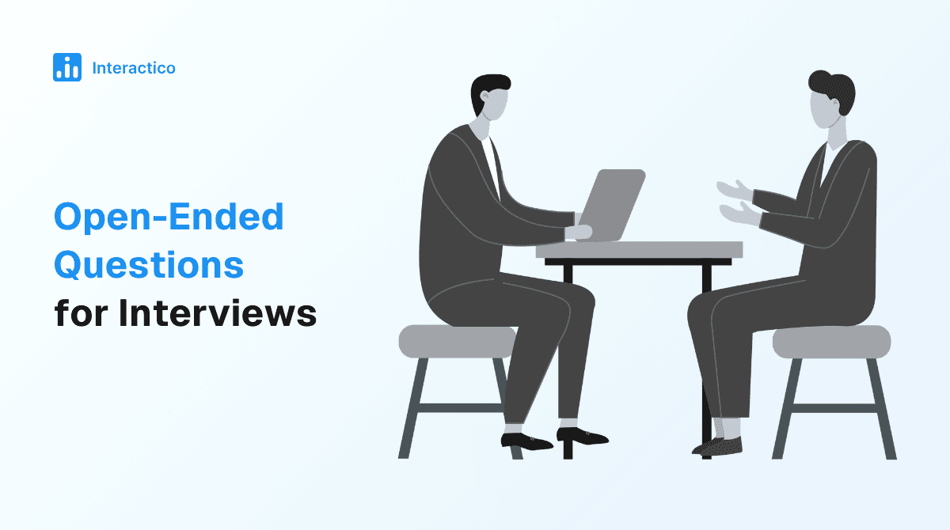
Short answers rarely reveal how someone thinks and solves problems. So, many recruiters rely on open-ended questions for interviews. This guide helps you discover what these questions are and presents a comprehensive list of effective questions to evaluate candidates thoughtfully.
What are Open-Ended Questions?
Open-ended questions are questions that cannot be answered with a simple “yes” or “no.” They encourage candidates to explain ideas, describe experiences, and provide detailed responses. In interviews, these questions help hiring managers understand how a candidate thinks and behaves in real workplace situations.
For example, a closed question is “Did you enjoy your previous role”? An open question would be “What aspects of your previous role did you find most rewarding”? The second question invites the candidate to share insights and experiences. Open-ended questions for interview conversations are widely used in modern recruitment processes.
They help interviewers evaluate communication skills, critical thinking, adaptability, and cultural fit.
Best Open-Ended Interview Questions
Below are useful open-ended questions for interviews organized by interview purpose. These questions help recruiters explore a candidate’s experience, mindset, and approach to work.
Core Open-Ended Interview Questions
These open-ended interview questions help recruiters understand a candidate’s background, interests, and professional journey.
- Can you walk me through your professional background and tell us about yourself?
- What professional accomplishment has been the most meaningful to you so far?
- What were your main responsibilities in your previous role?
- What attracted you to apply for this position?
- What have you learned about our organization so far?
- What strengths do you believe help you succeed in your career?
- What skill or area are you currently working on improving?
- How would your previous manager or supervisor describe your work style?
- What types of tasks or projects excite you the most?
- What qualities make you stand out from other candidates?
- What experiences have influenced your career choices the most?
- How do you personally define success in your professional life?
Behavioral Interview Questions (Past Experience)
Behavioral open-ended questions in an interview focus on past experiences to understand how candidates respond to real challenges.
- Can you share a time when you successfully overcame a major challenge at work?
- Tell me about a mistake you made and the lesson you learned from it.
- Describe a situation where you had to perform under significant pressure.
- Can you give an example of a time you worked with a very tight deadline?
- Tell me about a time when you helped resolve a workplace conflict.
- Describe an instance where you demonstrated leadership.
- Can you share a moment when you exceeded expectations in your role?
- Tell me about a time when you had to adjust quickly to change.
- Describe a situation where you improved an existing process or workflow.
- Tell me about a time when you received constructive criticism and how you handled it.
- Share an example where teamwork helped achieve a successful outcome.
- Tell me about a situation where you had to persuade someone to accept your idea.
Situational Interview Questions (Future-Focused)
Situational open-ended questions for interview discussions explore how candidates might respond to hypothetical workplace situations.
- How would you manage multiple tasks that have competing priorities?
- What approach would you take if you disagreed with your manager’s decision?
- How would you respond if a client gave negative feedback about your work?
- If you were assigned a project outside your expertise, how would you begin?
- What steps would you take if you realized you might miss a deadline?
- How would you handle a team member who is not performing well?
- What would you do if one of your ideas was rejected during a meeting?
- How would you quickly learn a new tool required for your job?
- What would you do if an unexpected problem occurred during a project?
- How would you proceed if the instructions for a task were unclear?
Personal and Motivational Questions
These open-ended interview questions help hiring managers understand what drives a candidate.
- What motivates you to perform at your best each day?
- What aspect of your profession do you enjoy the most?
- What type of work environment helps you perform well?
- What long-term career goals are you working toward?
- Where do you hope to see yourself professionally in five years?
- What factors drive your ambition at work?
- What would your ideal job look like?
- Which workplace values matter most to you?
- What helps you stay engaged and productive in your work?
- What inspires you professionally?
Strengths, Weaknesses, and Self-Reflection
These open-ended questions in an interview encourage candidates to reflect on their professional development.
- What professional strength has contributed the most to your success?
- What weakness are you actively working to improve right now?
- What feedback do colleagues or managers give you most often?
- How do you usually respond to constructive feedback?
- What professional challenge taught you the most valuable lesson?
- What skill are you currently trying to develop further?
- How do you maintain motivation during difficult periods at work?
- What habits have helped you succeed in your career?
- How do you manage workplace stress?
- What differentiates you from others working in your field?
Teamwork and Collaboration Questions
Teamwork-focused open-ended questions for interviews help evaluate collaboration and communication skills.
- How would you describe your preferred style of collaboration?
- Tell me about a successful team project you contributed to.
- How do you usually handle disagreements within a team?
- What role do you naturally take when working in a group?
- How do you build trust with coworkers?
- Describe a time when you supported a colleague at work.
- How do you communicate with cross-functional teams?
- In your opinion, what makes a team truly effective?
- How do you handle workplace conflicts?
- How do you ensure everyone in a team stays aligned with goals?
Leadership and Initiative Questions
Leadership-focused open-ended interview questions help recruiters evaluate decision-making and influence.
- How would you describe your leadership style?
- Tell me about a project where you took the lead.
- How do you motivate others on your team?
- Describe a situation where you took initiative without being asked.
- How do you decide when and how to delegate tasks?
- Tell me about a time you influenced an important decision.
- How do you maintain accountability within a team?
- How do you address underperformance in a team member?
- Tell me about a difficult decision you had to make at work.
- How do you encourage innovation within your team?
Converting Closed Questions Into Open-Ended Questions
Sometimes interview questions unintentionally limit candidates to short answers. Converting them into open-ended questions for interviews encourages richer responses.
Closed Question: Are you a team player?
Open Question: Can you describe your experience working in team environments?
Closed Question: Do you handle stress well?
Open Question: How do you usually manage stress in the workplace?
Closed Question: What is your strength?
Open Question: What is your strongest professional skill, and how has it helped you succeed?
Closed Question: Are you organized?
Open Question: How do you stay organized when managing several tasks at once?
Closed Question: Do you work well under pressure?
Open Question: Can you share an example of a time you worked under pressure?
Closed Question: Are you adaptable?
Open Question: Can you describe how you have adapted to unexpected changes at work?
Effective interviews go beyond basic questions. They focus on understanding how candidates think, solve problems, and collaborate with others. That is why open-ended questions for interviews play such an important role in modern hiring.
By asking thoughtful open-ended interview questions, you can evaluate experience, decision-making ability, leadership potential, and cultural fit more accurately. Structured feedback can make this process even more effective. Tools that capture and analyze responses help hiring teams compare candidates more fairly.
Want Better Interview Insights? Collect structured feedback, evaluate candidate responses, and compare interview insights with interactive tools.


Anurag Bhagsain is the Founder of Interactico. With a background in SaaS, product development, and automation, he is focused on solving real world problems, especially to make meetings truly interactive. With a love for blogging, he shares practical tips on audience interaction, polls, Q&A, and meeting best practices, turning them into simple, actionable ideas. Off hours, he enjoys coding and gaming.