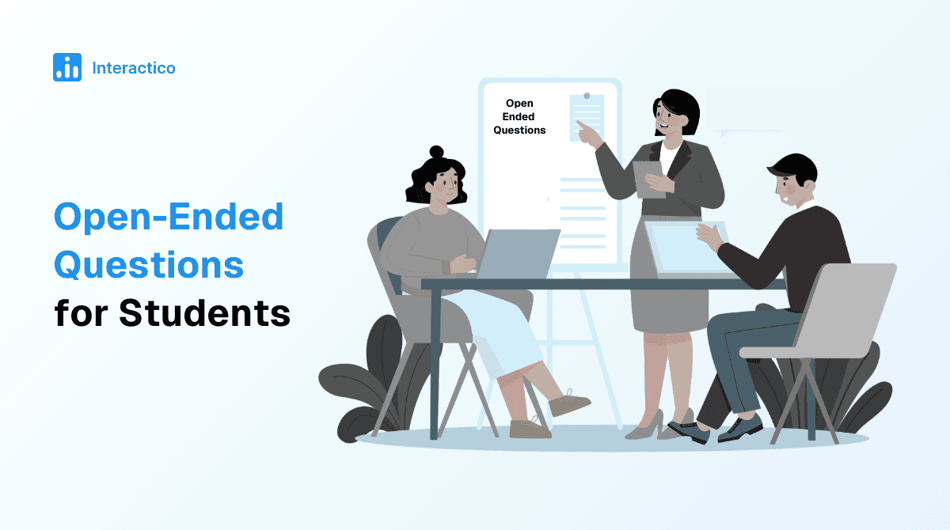
Open-ended questions for students are questions that require thoughtful, detailed answers rather than simple “yes” or “no” responses. They help students think critically and participate more actively in classroom discussions. Teachers use these questions to encourage creativity and a deeper understanding of lessons.
This guide explores practical examples, benefits, and tips for using open-ended questions effectively in the classroom.
What are Open-Ended Questions?
Open-ended questions are questions that cannot be answered with a simple “yes,” “no,” or a one-word response. Instead, they encourage students to think, explain, and describe their ideas in detail.
An example of an open-ended question for students can be like this: ask them, “What part of the story did you like the most and why”? Instead of simply asking them, “Did you like the story”?
An open-ended question for students invites discussion and deeper thinking because it compels students to explain their reasoning instead of giving short answers. These questions are widely used in modern classrooms because they help teachers understand how students think.
Why are open-ended questions important for Students?
Open-ended questioning is considered an important strategy in student-centered learning. They help students:
- Develop Critical Thinking: Students analyze ideas instead of memorizing facts.
- Improve Communication Skills: Learners practice explaining thoughts clearly and using descriptive language.
- Build Confidence: When students share ideas openly, they become more comfortable participating in class discussions.
- Encourage Creativity: Students can explore multiple perspectives instead of looking for one “correct” answer.
- Support Deeper Understanding: Teachers can see how well students understand a topic by listening to their explanations.
How Do Open-Ended Questions Support Thinking Beyond “Yes/No”?
Traditional classroom questions often check memory. Students only recall facts. Open-ended questions do something different. They encourage students to:
- Analyze information
- Evaluate ideas
- Make connections
- Reflect on experiences
- Propose solutions
For example, instead of asking: “Is pollution harmful”? A teacher might ask: “How do you think pollution affects the environment and people’s health”? Now the student must explain their understanding. For that, they first need to be aware, gather knowledge, reflect, and comprehend. This process strengthens reasoning and problem-solving skills.
Examples of Open-Ended Questions for Students (By Category)
Here are useful open-ended question examples for students, organized by classroom purpose.
Academic & Critical Thinking Questions
These questions encourage students to analyze ideas and connect concepts.
- What aspects of this subject most intrigue or surprise you?
- How would you describe this idea to someone unfamiliar with it?
- What is an example of what we are studying in real life?
- Which aspect of this assignment was the most difficult, and why?
- How does this relate to the previous week’s lessons?
- Is there another way we could approach this problem?
Reflection & Growth Mindset Questions
Reflection questions help students evaluate their learning process.
- What is a growth mentality, and why is it crucial?
- What went wrong today, and what did you take away from it?
- What objective are you pursuing, and how did you get there today?
- What recent adjustments have you made to improve your learning skills?
- When you don’t grasp a concept, what do you do?
- In this lesson, describe what it means to be a good learner.
- What challenges did you face today, and why?
- How hard did you work to learn today?
- How do you react to constructive criticism?
Social-Emotional & Getting-to-Know-You Questions
These fun open-ended questions for students help build classroom relationships.
- Which recent act of compassion stands out in your memory?
- What qualities distinguish a good friend?
- Do you possess any unique skills or hidden talents?
- If you could pick up any new skill right now, what would it be and why?
- What good deed from a classmate brightened your day?
- What qualities make a person an excellent classroom partner?
- In five words or fewer, how would you characterize yourself as a student?
- What academic achievement are you proud of?
- Outside of class, what is your favorite pastime?
- What good deeds could our class perform as a group?
Creative & Hypothetical Questions
Creative questions encourage imagination and storytelling.
- What would you do if you were a teacher for a day?
- What would you celebrate if you could create a new holiday?
- If you were in this story’s setting, how would you respond?
- If you could focus on just one subject, what would it be and why?
- If you could impart one skill to your peers, what would it be?
- In class, when do you feel most confident, and what makes you feel that way?
- Why do you believe that making mistakes is a necessary element of learning?
- Why do you think people can learn new things through reading stories?
Open-Ended Questions for Science
Science questions encourage observation and exploration.
- If it didn’t rain for several months, what do you suppose would happen?
- Why do some materials carry electricity better than others?
- How do animals endure extremely cold temperatures?
- What role do genetic changes play in the development of antibiotic resistance?
- Why does mental health depend on the environment?
- Which solutions for renewable energy might be viable in the long run?
- What is the relationship between neurobiology and psychology?
- How can scientists enhance techniques for detecting earthquakes?
- Why do human bones weigh so little?
- Which scientific invention is the most significant, and why?
Open-Ended Questions for Mathematics
Math questions help students connect numbers with real life.
- How is math used in your day-to-day activities?
- Why does estimating help with issue-solving?
- How can financial markets be predicted using mathematical models?
- How can engineering challenges be solved using differential equations?
- What occurs if measurements are inaccurate?
- How do graphs improve our comprehension of information?
- How does probability affect the process of making decisions?
- What impact does game theory have on economics?
- What are artificial intelligence’s mathematical underpinnings?
- What role does math play in technology?
Open-Ended Questions for Different Age Groups
Different students respond to different types of questions. Here is a list of open-ended questions based on age, for elementary students, high school, middle school, and even kindergarten.
Preschool & Kindergarten
These questions focus on curiosity and imagination.
- What noises do you hear at the park?
- What gives you the desire to dance?
- For what do you feel grateful today?
- What would your toys say if they were able to speak?
- How can we construct an extremely tall block tower?
- What do you anticipate the story’s next development?
- Why did you create that image?
- Which toy is your favorite, and why?
- Tell me the tale you like best from circle time.
Elementary School
These open-ended questions for elementary students encourage reasoning.
- What aspect of today’s arithmetic challenge surprised you the most?
- What relevance does this scientific experiment have to everyday life?
- Why, in your opinion, did the character behave in that manner throughout the narrative?
- How would you approach this puzzle in a different way the next time?
- What trends do you observe in the chronology of history?
- How would you instruct a friend on how to spell this word?
- During group work, what did you learn about fractions?
- Why is cooperation crucial for class projects?
- What query do you still have about the lesson from today?
- What impact does weather have on geography?
Middle School
These open-ended questions for middle school students focus on analysis for critical subjects, including social science, algebra, literature, and more.
- What aspect of the historical lecture today piqued your interest the most, and why?
- How would you use this algebraic idea to solve a practical issue?
- In the book we are reading, what theme do you see?
- Why does our biological unit’s ecosystem change?
- How do you think science and current affairs are related?
- How can we make our group debate approach better?
- Before learning about this physics topic, what assumption did you have?
- What social studies evidence backs up your beliefs?
- In what ways does vocabulary enhance writing abilities?
- In civics lessons, why could governments make particular decisions?
High School
These open-ended questions for high school students encourage deeper evaluation.
- What impact does this literary analysis have on your perspective?
- What practical uses does calculus have?
- What makes you agree or disagree with the author’s position?
- How do policy decisions get influenced by climate data?
- What moral dilemmas do economic simulations raise?
- How might you improve the outcomes of this lab experiment?
- What are the holes in our history curriculum, and why are they important?
- How does rhetoric function in discussions?
- In what ways has this psychology lecture altered your perception of yourself?
- What makes interdisciplinary learning crucial for complex projects?
How to Ask Open-Ended Questions in the Classroom: Important Hacks!
These simple tips can help you ask open-ended questions effectively
- Integrate Them Into Daily Discussions: Use open-ended questions during lessons, homework, and group work.
- Encourage Critical Thinking: Ask questions that require reasoning and explanation.
- Keep Questions Simple and Clear: Students should understand the question easily before answering.
- Use Technology to Create Interactive Learning: Digital tools allow teachers to collect and analyze student responses instantly.
Platforms like Interactico help educators run live polls, gather written responses, and understand student thinking in real time.

- Give Students Time to Respond: Allow a few minutes for students to think before answering.
- Create a Safe Learning Environment: Students should feel comfortable sharing opinions without fear of judgment.
- Provide Real-Time Feedback: Respond to student answers and guide them toward deeper thinking.
Open-ended questioning is a powerful teaching strategy that encourages deeper thinking and meaningful classroom discussions. When teachers use open-ended questions for students, they move learning beyond simple memorization. Students analyze ideas, express opinions, and connect concepts to real life.
From preschool classrooms to high school discussions, these questions support curiosity, creativity, and critical thinking. Interactive classroom tools can make this process even more effective.
Turn everyday lessons into interactive learning moments with Interactico.

FAQs
Open-ended questions are questions that cannot be answered with just “yes,” “no,” or one-word responses. They encourage students to explain ideas, share opinions, and give detailed answers.
Inclusive questions help teachers understand students’ experiences, interests, and perspectives. When students share their stories, it builds trust and strengthens classroom relationships.
They encourage students to explain why something happens, how it works, or what solutions might work best. This strengthens reasoning and problem-solving skills.
Teachers can ask them during storytelling, reading discussions, science experiments, math activities, group projects, and reflection after lessons.
Students practice speaking in full sentences, using descriptive language, and explaining their ideas clearly. Over time, this improves both speaking and writing skills.
Teachers can ask them daily. Even 5-10 minutes of open discussion in each lesson can significantly improve thinking and communication skills.

Anurag Bhagsain is the Founder of Interactico. With a background in SaaS, product development, and automation, he is focused on solving real world problems, especially to make meetings truly interactive. With a love for blogging, he shares practical tips on audience interaction, polls, Q&A, and meeting best practices, turning them into simple, actionable ideas. Off hours, he enjoys coding and gaming.