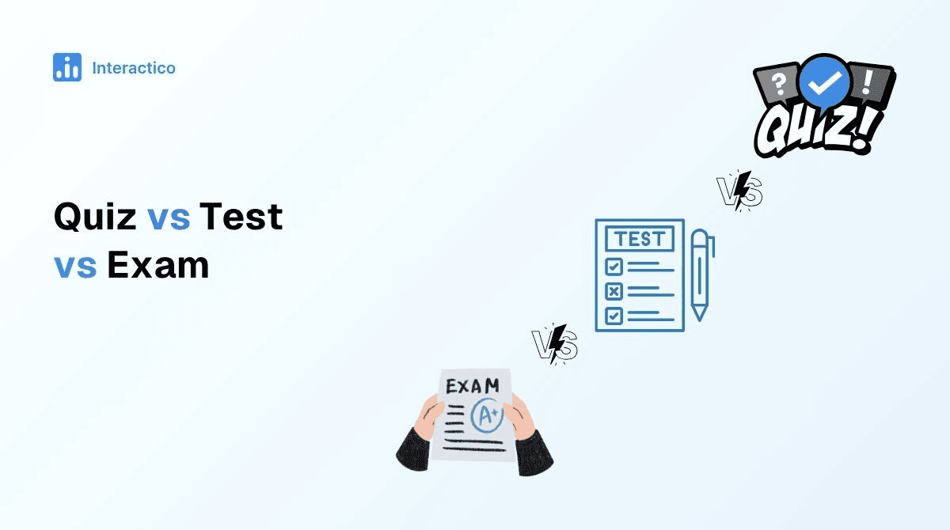
Quiz vs Test vs Exam: What’s the Difference?
You hear these three words all the time in classrooms and training sessions. Quiz, test, exam. People often use them like they mean the same thing. But they don’t. Each one plays a different role in learning.
In this blog, we are taking a look at what a quiz, test, and exam actually mean, how they differ from each other, and why knowing this matters when you are teaching or learning.
What is a Quiz?
A quiz is the quickest way to check if someone is following along. It usually happens right after a concept is taught or while the topic is still fresh.
Think of it like this. You explain something, and instead of moving ahead blindly, you pause and ask a few questions. That pause is your quiz.
It is short. It does not try to cover everything. It focuses only on what was just discussed. Because of that, quizzes feel light and manageable.
Most quizzes are not meant to put pressure on the learner. They are more about practice than judgment. If someone gets answers wrong, it is not seen as failure. It simply shows what needs a bit more attention.
From a teacher’s side, quizzes are very useful. They give quick signals. If half the class misses a question, you immediately know something did not land properly. You can fix it then and there instead of finding out much later.
In simple terms, a quiz is a quick check that keeps learning on track.
What is a Test?
A test takes things a step further. Instead of looking at one small part, it looks at a larger portion of what has been taught.
Tests usually happen after finishing a chapter, unit, or training phase. By this time, learners are expected to not just remember facts but also connect ideas.
This is where the nature of questions starts to change. You may still see objective questions, but there will also be questions that ask for explanation, reasoning, or problem solving.
Tests carry more importance than quizzes. The scores are often recorded. They may contribute to grades or performance tracking. Because of this, learners take them more seriously.
At the same time, tests are not as intense as exams. They sit somewhere in the middle. They check progress, not final mastery.
If you had to describe a test in one line, it would be this. It shows how well someone has understood a chunk of learning over time.
What is an Exam?
An exam is where everything comes together. It is not about one topic or one unit. It looks at the entire course or a large portion of it.
By the time someone sits for an exam, the expectation is different. It is no longer about basic understanding. It is about how well they can apply, explain, and use what they have learned.
Exams are more formal. They follow a fixed structure. They are usually scheduled in advance and conducted under controlled conditions.
They also carry the most weight. The outcome of an exam can affect grades, certifications, promotions, or future opportunities. That is why the pressure around exams is higher compared to quizzes and tests.
The format is also more detailed. Exams often include a mix of question types. Some check memory. Some check understanding. Others check how well a learner can think through a situation or solve a problem.
So if quizzes are quick checks and tests are progress checks, exams are the final picture.
Difference Between Quiz vs Test vs Exam
Let’s put everything side by side so you can see the difference clearly:
| Feature / Aspect | Quiz | Test | Exam |
|---|---|---|---|
| Purpose | Used to quickly check if students understood a recent lesson or concept. | Used to evaluate learning after completing a unit or chapter. | Used to assess overall understanding across multiple units or the entire syllabus. |
| Length | Short. Usually 5 to 15 minutes. | Medium length. Can range from 30 minutes to 1 hour. | Long. Often 1 to 3 hours depending on the subject and level. |
| Frequency | Conducted frequently. Can be weekly or even daily. | Conducted less often, usually after completing a topic. | Conducted at the end of a term, semester, or academic year. |
| Syllabus Coverage | Limited to a small portion of the topic. | Covers one chapter or a set of related topics. | Covers a wide portion of the syllabus or the full subject. |
| Difficulty Level | Basic. Focuses on recall and simple understanding. | Moderate. Includes application-based questions. | Can range from moderate to advanced. May include analytical and long-answer questions. |
| Question Types | Mostly objective. MCQs, fill in the blanks, true or false. | Mix of objective and short answer questions. | Mix of objective, short answer, and long descriptive questions. |
| Preparation Required | Minimal. Students can prepare quickly. | Requires revision of the full chapter or topic. | Requires thorough preparation across multiple topics. |
| Impact on Grades | Low weightage. Often used for practice or internal assessment. | Moderate weightage. Contributes to overall performance. | High weightage. Plays a major role in final results. |
| Teacher’s Role | Helps you quickly identify gaps in understanding and adjust your teaching. | Helps you measure how well students have grasped a topic before moving ahead. | Helps you evaluate overall learning and readiness for the next level. |
| Feedback and Correction | Immediate or quick feedback is usually given. | Feedback may take a bit longer but is still timely. | Feedback can take longer due to detailed evaluation. |
| Stress Level for Students | Low. Students usually do not feel much pressure. | Moderate. Students take it more seriously. | High. Students often feel pressure due to its importance. |
| Use in Classroom | Useful for quick checks, warm-ups, or exit tickets. | Useful for structured assessment after teaching a concept. | Used for formal evaluation at the end of a learning cycle. |
When to Use Quizzes vs Tests vs Exams
Understanding the difference is helpful, but what actually matters is knowing when to use each one. That is where most people get confused.
Let’s start with quizzes.
Use Quizzes When:
- You want to strengthen fresh learning. Right after teaching something, a short quiz helps learners go back to it and think again. This simple step improves memory without making it feel like a formal test.
- You feel attention dropping. Long sessions can become heavy. A quick quiz breaks that pattern and pulls learners back in. It gives them something to do instead of just listening.
- You want instant clarity. Instead of guessing whether people understood, a quiz gives you a clear answer within minutes. You can adjust your teaching immediately.
- You are trying to reduce fear around assessments. When quizzes become regular, they stop feeling scary. Learners get used to answering questions without pressure.
Use Tests When:
- You want to see how learning is holding up over time. After a few lessons or a full unit, a test helps you understand whether learners are actually connecting ideas or just remembering bits and pieces.
- You need something you can record and compare. Tests give you a clearer picture of performance. You can track scores, see improvement, and even identify patterns across a group.
- You are moving learners through stages. In structured learning setups, tests act like checkpoints. They help you decide who is ready to move forward and who might need more support before continuing.
- You want to bring in some seriousness without overwhelming pressure. Tests carry weight, but they are not as heavy as exams. This makes them useful for building discipline and preparation habits gradually.
A good learning setup does not rely on tests alone. When quizzes prepare learners step by step, tests become more meaningful and less stressful.
Use Exams When:
- You want to understand the full picture. Exams are not about one topic or one phase. They look at everything that has been covered and check how well it all fits together in the learner’s mind.
- You are making decisions that matter. Exams are usually tied to outcomes like passing a course, earning a certificate, or moving to the next level. That is why they carry more importance.
- You need consistency across learners. Exams follow a structured format so that everyone is evaluated on the same level. This helps maintain fairness, especially in larger systems like schools or professional programs.
- You want to check depth, not just surface understanding. Exams often include questions that require thinking, explanation, and application. They go beyond memory and look at how well someone can use what they have learned.
- You are ensuring accountability. In many settings, exams act as proof that learning has actually taken place. This is important for institutions, employers, and regulatory bodies.
Closing Thoughts
Quizzes, tests, and exams are not competing tools. They are parts of the same system. Each one supports learning in a different way.
Quizzes keep things active and help learners stay engaged. Tests give you a sense of direction and show whether progress is happening. Exams bring everything together and show the final outcome.
When you use them thoughtfully, learning becomes more balanced. It is no longer just about preparing for one big moment. It becomes a continuous process where understanding builds step by step.
FAQs
In a broad sense, yes. A quiz is a type of test. But in practice, the intention is different. Quizzes are shorter and used more frequently. They help learners practice and improve. Tests are more structured and are used to evaluate understanding over a larger portion of content.
A quiz is one small way to check understanding. An assessment is a wider term. It includes quizzes, tests, exams, and even observations or projects. While quizzes focus on immediate learning, assessments look at overall growth and performance.
They support different stages of learning. Quizzes help learners stay on track and fix mistakes early. Tests check how well learning is building over time. Assessments bring everything together and show the bigger picture. When used together, they create a smoother learning journey.
An exam is a detailed and comprehensive form of test. It looks closely at a learner’s understanding across a large portion of content and often includes different types of questions to check both knowledge and application.
They are related, but not exactly the same. Both are used to check knowledge, but exams are more formal and carry more importance. Tests are usually smaller in scope and happen more often.
No, a quiz is much lighter and more informal. It is used for quick checks during learning. Exams are more structured and are used to measure overall understanding with higher stakes.

Anurag Bhagsain is the Founder of Interactico. With a background in SaaS, product development, and automation, he is focused on solving real world problems, especially to make meetings truly interactive. With a love for blogging, he shares practical tips on audience interaction, polls, Q&A, and meeting best practices, turning them into simple, actionable ideas. Off hours, he enjoys coding and gaming.