Key Takeaways
- A Likert scale measures agreement with a statement, typically using a 5-point or 7-point scale ranging from strongly disagree to strongly agree.
- A rating scale is a broader survey method used to measure satisfaction, performance, or intensity through formats like numbers, stars, sliders, or labels.
- All Likert scales are rating scales, but not all rating scales follow the Likert format.
- Likert scales are best for measuring attitudes and opinions, especially in research surveys, employee engagement studies, and social science research.
- Rating scales are ideal for quick feedback, such as customer satisfaction surveys, product reviews, and performance evaluations.
The difference between a Likert scale and a rating scale lies in how each measures responses in surveys. A Likert scale asks respondents to show their level of agreement with a statement, while a rating scale measures satisfaction, quality, or intensity. This guide explains their differences, examples, and when to use each for better survey results.
What is a Likert Scale?
A Likert scale is a survey measurement tool used to capture attitudes, opinions, or behaviors. It usually presents a statement and asks respondents to indicate how strongly they agree or disagree with it. The scale typically uses 5-point or 7-point options, ranging from one extreme opinion to another.
The method was developed by researcher Rensis Likert to measure subjective opinions in a structured way.
Key Characteristics of the Likert Scale
A Likert scale has several defining features, including:
- Statement-Based Structure: Respondents react to a statement rather than a direct question. Example: “I am satisfied with the training provided.”
- Ordered Response Options: Participants select from a series of responses that represent levels of agreement or intensity.
- Neutral Midpoint: Most Likert scales include a neutral option, such as “Neither agree nor disagree.” This allows respondents to remain neutral.
- Quantifiable Data: Each response is assigned a number, often from 1 to 5 or 1 to 7. This allows researchers to calculate averages and analyze trends.
Common Examples of Likert Scale
Agreement Scale:
- Strongly disagree
- Disagree
- Neutral
- Agree
- Strongly agree
Satisfaction Scale
- Very dissatisfied
- Dissatisfied
- Neutral
- Satisfied
- Very satisfied
Frequency Scale
- Never
- Rarely
- Sometimes
- Often
- Always
These structured options make Likert scales useful for measuring perceptions and attitudes in surveys.
If you want to see how these questions are used in real surveys, explore this guide on Likert scale questions.
What is a Rating Scale?
A rating scale is a survey tool that measures opinions, satisfaction, performance, or behaviors by asking respondents to choose a value along a continuum. Unlike Likert scales, rating scales can appear in many formats, such as numbers, stars, descriptive labels, or visual sliders. Because of this flexibility, rating scales are commonly used in:
- Customer satisfaction surveys
- Employee performance reviews
- Product feedback forms
- Market research studies
Key Characteristics of Rating Scale
This is how rating scales work:
- Flexible Format: Rating scales may use numbers, symbols, labels, or graphics. The examples include:
- 1-5 numerical ratings
- 1-10 satisfaction scores
- Star ratings
- Slider scales
- Measures Degree or Intensity: Respondents rate something based on quality, performance, or satisfaction.
- Converts Feedback Into Data: Responses are usually converted into numerical values, which helps researchers analyze trends and averages.
Common Examples of Rating Scale
Numeric Rating
- Rate your satisfaction from 1 to 10.
Star Rating
- Rate this product: ★★★★★
Slider Scale
- Move the slider to show how satisfied you are.
Semantic Differential Scale
- Boring → Exciting
- Difficult → Easy
If you want to design effective survey questions, this guide on rating scale questions explains different formats and examples.
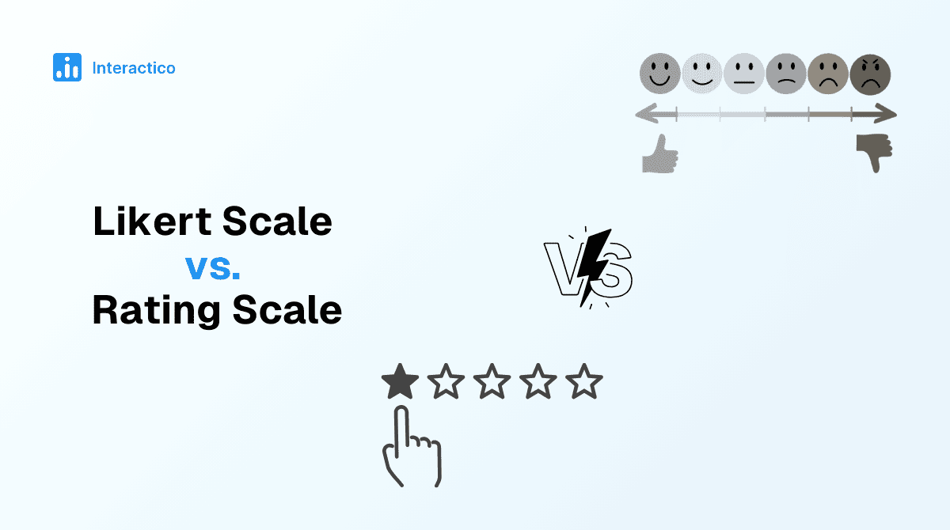
Likert Scale vs Rating Scale
Although these terms are often used interchangeably, they are not exactly the same. Understanding Likert vs. rating scale differences helps you choose the right survey design.
| Comparison Factor | Likert Scale | Rating Scale |
|---|---|---|
| Meaning | A structured survey scale designed to measure how strongly respondents agree or disagree with a statement. | A general measurement method used to assess satisfaction, quality, performance, or intensity. |
| Scope | A specific type of rating scale commonly used in research surveys. | A broader category that includes Likert scales, numeric ratings, stars, sliders, and similar formats. |
| Main Purpose | Evaluates respondents’ level of agreement or attitude toward a statement. | Measures levels such as satisfaction, frequency, quality, or performance. |
| Typical Format | Often presented as a 5-point or 7-point scale ranging from “Strongly Disagree” to “Strongly Agree.” | May appear as numeric ranges (1-5, 1-10), star ratings, sliders, or other visual scoring systems. |
| Data Type | Produces ordinal data that researchers sometimes treat as interval data during analysis. | Usually generates ordinal data, though it may function as interval data depending on the scale design. |
| Response Labels | Most response options include clear descriptive labels. | Some scales use only numbers, while others label only the endpoints. |
| Common Applications | Widely used in academic research, psychology studies, employee engagement surveys, and social science research. | Common in customer feedback surveys, product reviews, service evaluations, and app ratings. |
| Example Question | “I am satisfied with the service.” (Strongly Disagree → Strongly Agree) | “Rate your satisfaction from 1 to 10.” |
| Primary Focus | Capturing attitudes, opinions, and perceptions. | Measuring satisfaction, quality, performance, or intensity. |
| Data Analysis | Responses are often averaged to evaluate overall sentiment or opinion trends. | Scores are typically used for comparisons, rankings, and performance evaluation. |
| Survey Design Effort | Requires carefully written statements and balanced response options. | Easy to create and quick for respondents to answer. |
| Best Use Case | Ideal for detailed opinion research and behavioral studies. | Best for gathering quick, straightforward quantitative feedback. |
Likert vs. Rating Scale: When Should You Use Each Scale?
Choosing between a rating vs likert scale depends on what you want to measure.
Use a Likert Scale When:
- You want to measure attitudes or perceptions
- You are conducting academic or research surveys
- You need detailed opinion data
- You want balanced responses with a neutral option
- Example: Employee engagement surveys.
Use a Rating Scale When:
- You want quick feedback
- You need performance scores or satisfaction ratings
- You are measuring product or service quality
- You want a simple survey experience
Example: Customer satisfaction surveys.
Understanding the difference between a Likert scale and a rating scale helps you design surveys that capture more accurate and meaningful feedback. A Likert scale focuses on measuring attitudes and agreement with statements, while a rating scale provides a flexible way to evaluate satisfaction, performance, or quality.
Want Smarter Survey Feedback? Design engaging surveys and gather real-time responses to turn feedback into actionable insights.

FAQs
The main difference between a Likert scale and a rating scale is scope. A Likert scale measures agreement with a statement using structured options, while a rating scale is a broader tool used to evaluate satisfaction, quality, or performance.
No. A Likert scale is a type of rating scale, but not all rating scales follow the Likert format.
Yes. Every Likert scale is a rating scale because respondents rate their level of agreement. However, rating scales also include numeric, star, and slider formats.
Common types of rating scales include:
You should use a Likert scale when you want to measure opinions, perceptions, or attitudes, especially in research surveys, employee feedback forms, and social science studies.

Anurag Bhagsain is the Founder of Interactico. With a background in SaaS, product development, and automation, he is focused on solving real world problems, especially to make meetings truly interactive. With a love for blogging, he shares practical tips on audience interaction, polls, Q&A, and meeting best practices, turning them into simple, actionable ideas. Off hours, he enjoys coding and gaming.